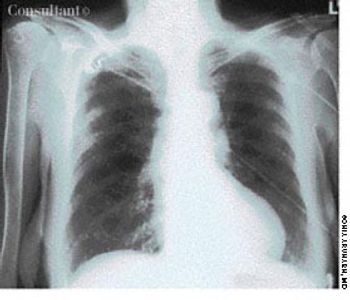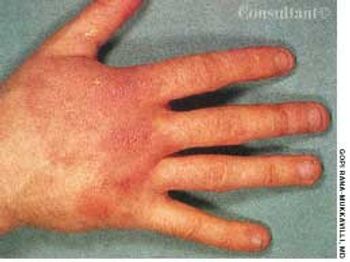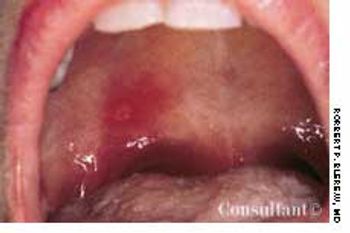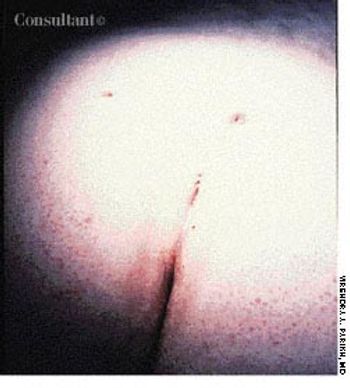
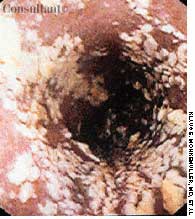





























































































































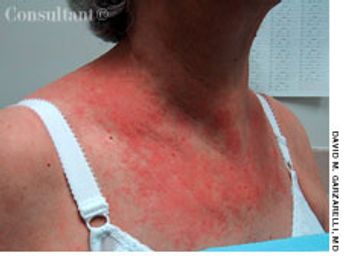
A 72-year-old nursing home resident was hospitalized with fever, chills, and rigors of 2 days' duration. The nursing home staff reported the patient had dysphagia after a recent stroke.


A 72-year-old nursing home resident was hospitalized with fever, chills, and rigors of 2 days' duration. The nursing home staff reported the patient had dysphagia after a recent stroke.

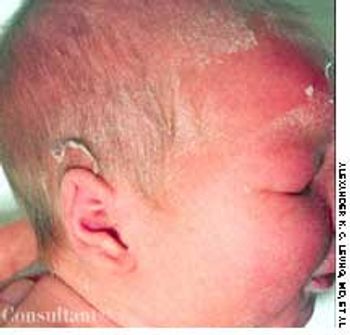
Following an uncomplicated pregnancy, a 30-year-old gravida 2, para 1 mother delivered a term infant boy. The neonate's Apgar scores were 7 at 1 minute and 9 at 5 minutes. Birth weight was 3.2 kg (7.1 lb); length, 50 cm (19.7 in).

Erythematous, scaly lesions with double-edged borders had been present on a 14-year-old boy's left upper arm and lower legs for about a year. The lesions were occasionally pruritic, and some resembled ringworm. At times, fine yellow crusting suggestive of impetigo was present. The boy took very hot baths and showers.

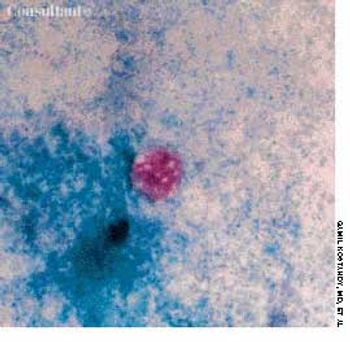
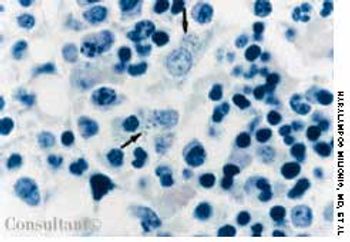
Fever occurring twice daily, accompanied by profuse sweating, anorexia, and malaise of 15 days' duration resulted in hospitalization of a 31-year-old woman. At this time, her temperature was 37.6°C (99.7°F); blood pressure, 110/70 mm Hg; pulse rate, 90 beats per minute; and respiratory rate, 18 breaths per minute. A palpable spleen was about 3 to 5 cm below the left subcostal margin. Neither lymphadenopathy nor hepatomegaly was noted.

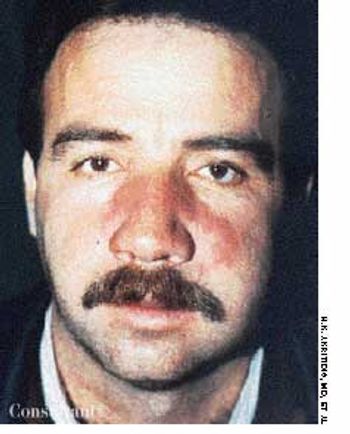
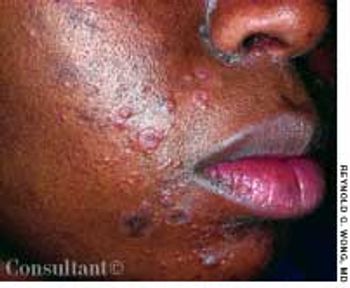
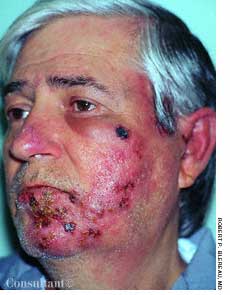
An eruption on the face of a 49-year-old woman had been misdiagnosed as a staphylococcal infection; the rash failed to respond to oral and topical antibiotics. A mid-potency topical corticosteroid also had been tried, but the eruption worsened.

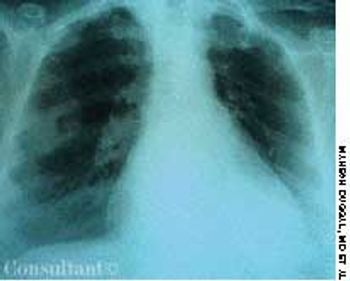
A 22-year-old man complained of progressive shortness of breath and abdominal distention. Three years before, he had completed chemotherapy for Hodgkin's disease and had since been in remission. Recently, he had been treated for tonsillitis with oral antibiotics.

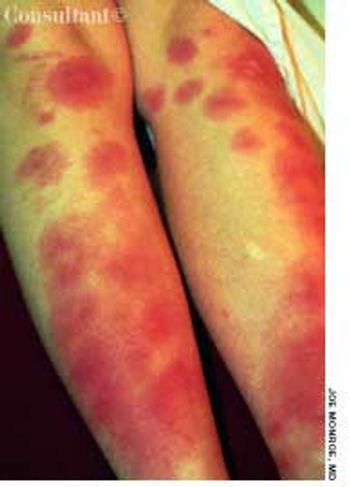
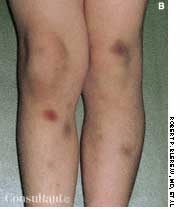
An otherwise healthy 36-year-old woman complained of multiple tender, hot, bright red nodules of acute onset on her thighs and anterior tibial areas. Antibiotics had been given for a suspected infection, but the rash persisted.

The widespread eruption of asymptomatic macules and flat, palpable, flesh-colored lesions prompted a 23-year-old woman to consult her physician. The lesions-some of which had dark centers-were concentrated on the patient's face, neck, and upper back; the palms, soles, anal mucosa, and genital areas were clear. The patient denied systemic symptoms. She was seronegative for HIV.

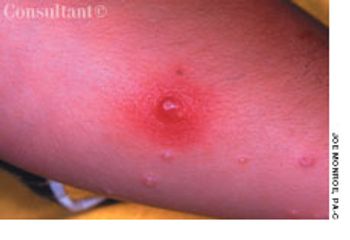
A papule on the leg of an 11-year-old boy had suddenly developed into a slightly tender pustule. The pustule had not responded to oral cephalexin and topical mupirocin prescribed by another clinician.

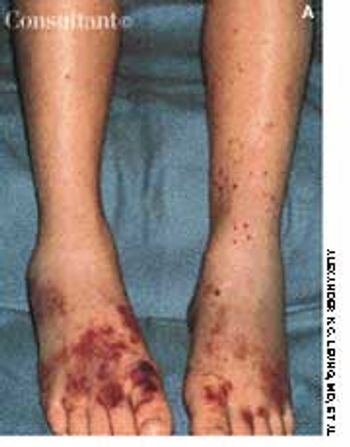
Two 7-year-olds show the purpuric rash of the lower body and legs that is typical of Henoch-Schönlein purpura. This disease is a vasculitis that chiefly affects small vessels of the skin, joints, gastrointestinal tract, and kidney.

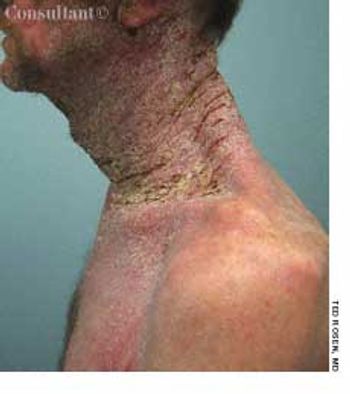
A 52-year-old white man presented with a pruritic eruption on the neck of 3 months' duration. The rash had not responded to a potent topical corticosteroid prescribed by another practitioner for the presumed diagnosis of eczema.

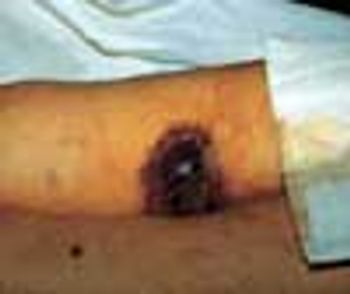
A 13-year-old girl who had leukemia presented to the emergency department with fever; chills; weight loss; fatigue; and a painful, erythematous rash with a central black lesion on the upper thigh. The patient was neutropenic and had been undergoing chemotherapy for 1 week.

A healthy 31-year-old man was referred to a dermatologist with a diagnosis of tinea versicolor that did not respond to oral ketoconazole and topical selenium sulfide.

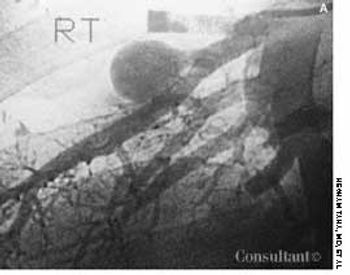
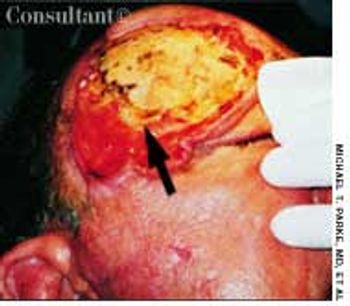
Shortly after arriving from Puerto Rico, a 59-year-old man presented with right-sided frontal head pain and decreased vision in his right eye. He was concerned about a “sore” that first developed 9 months earlier on his head. The patient denied fever, chills, and syncope.

The wounds on the back of this boy's head are the result of an encounter with his neighbor's dog. The youngster's anxious parents brought him in for evaluation 1 hour after he was bitten.

A 46-year-old man with diabetes presented for evaluation of gradual fingernail deterioration, which had failed to respond to several courses of griseofulvin and a recent 3-month course of daily terbinafine. The patient-who worked as a bartender-was otherwise healthy.

Acute herpes zoster ophthalmicus of the right eye was diagnosed in a 70-year-old woman by her primary care physician, who prescribed oral acyclovir. After 1 week of therapy, the patient's eye became red and painful and she experienced photophobia and epiphora. She was referred for consultation.

Severe shortness of breath, a dry cough, and a 10-day history of fever sent a 37-year-old man with HIV disease to the emergency department. He complained of a poor appetite and had lost 10 lb over the last 10 days.

A 35-year-old Nigerian man presented to the emergency department with a distended, tender abdomen; fever; and weight loss. His abdomen had grown increasingly large during the past several months as his appetite diminished. The patient reported no allergies, took no medication, and denied tobacco, alcohol, and illicit drug use. His only significant medical history was jaundice during adolescence.

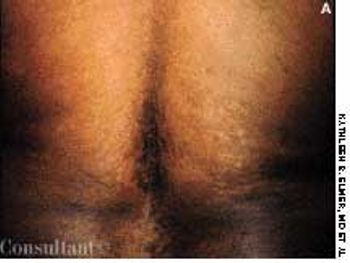
For 3 years, a 53-year-old man had noted increasingly extensive changes in his skin, including facial thickening, a progressive reddish tinge, and annular lesions on his trunk. He also complained of itching on the periphery of his face.

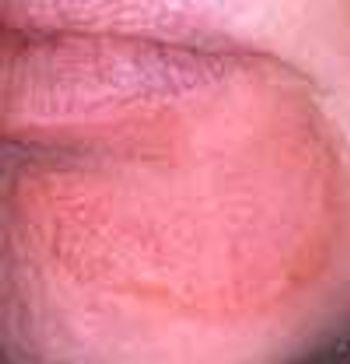
During the past 2 weeks, a 34-year-old man with HIV infection experienced worsening mouth pain while chewing.

Exquisite pain of 3-days' duration in his right index finger sent a 19-year-old man for medical consultation. He recalled that a thorn had become embedded in the finger while gardening 1 week earlier.

A 42-year-old woman had had athlete's foot for years, but the condition suddenly worsened when inflamed, pruritic vesicles appeared on both feet. A few days later, tiny, mildly itchy vesicles erupted on her palms; the rest of the hands were not involved. One week after the palmar eruptions, the patient noted 2 round, reddish brown, asymptomatic 3-cm macules on her trunk. These lesions had faint scaling on the trailing edge of the slowly advancing arciform borders.

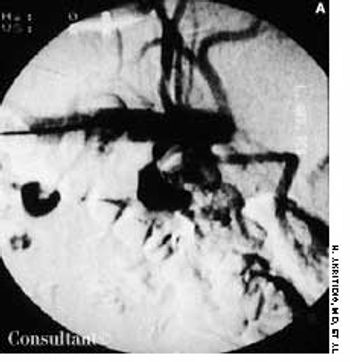
Adhesions can form within the peritoneal cavity after abdominal surgery, especially if there is an underlying inflammatory condition such as appendicitis or inflammatory bowel disease. The incidence of adhesive intestinal obstruction following a laparotomy is approximately 2%. Most adhesive obstructions occur within 3 months of the laparotomy, and 80% occur within 2 years. Adhesive obstructions tend to be more common in children than in adults.

Enterobiasis-an infection by pinworms-is caused by the nematode Enterobius vermicularis. Treatment is a single dose of oral albendazole, mebendazole, or pyrantel pamoate.