Infectious Disease

Latest News


CME Content


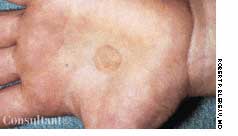
For years, a 39-year-old man had an eruption on his hand, which seemed to be controlled with topical corticosteroids. The patient was a rancher.

Myiasis

The parents of a 12-year-old sought a consultation for the “cyst” that had appeared on their daughter's lower back. The lesion was first noticed 2 months earlier upon the child's return from a trip to Belize.

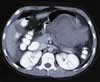
Three weeks after undergoing gastric bypass surgery for obesity, a 64-year-old woman presented with fatigue, chills, and abdominal pain of 2 days' duration. She denied shortness of breath, nausea, vomiting, changes in bowel habits, melena, and hematochezia. The patient had no significant past medical history.

Filariasis

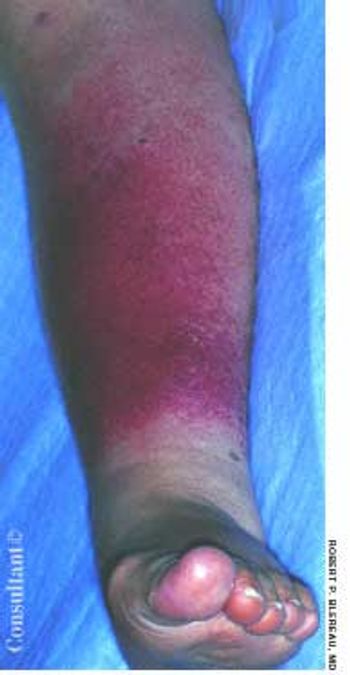
A 16-year-old boy was evaluated for elephantiasis in a remote village in the mountains of Kenya. He complained of drainage from his left leg and reported that for the past several months, after the limb swelled, fluid began to weep from the bottom of the foot. He denied pain in his leg or foot and reported no fever, chills, or sweats.

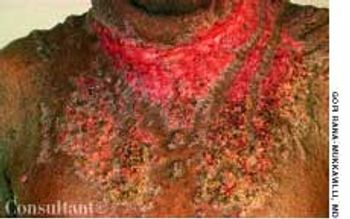
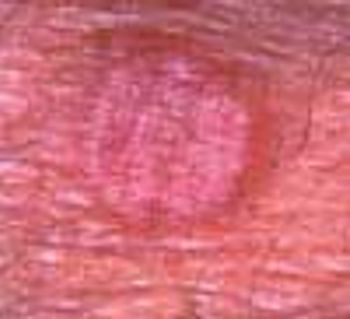
A 62-year-old woman presented with an itchy, annular eruption on her face of 3 months' duration. A topical antifungal was prescribed, but the slow response to therapy prompted a switch to a topical corticosteroid (triamcinolone 0.1%). The lesion not only failed to clear but became larger.

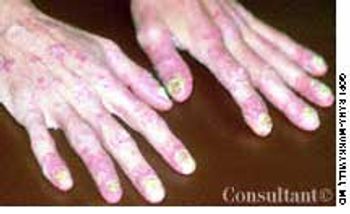
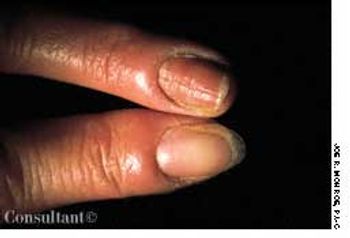
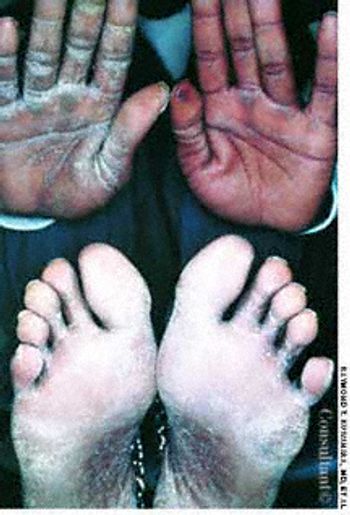
For about 4 months, a very dry, diffuse, fine scaly, asymptomatic eruption covered the palms of a 28-year-old man; several fingernails were dystrophic bilaterally as well. Before the onset of this condition, bilateral onychomycosis of the toenails had been diagnosed.

A 22-year-old soldier's left hand, wrist, and distal forearm were crushed by an object that weighed 90.8 kg (200 lb). There were no signs of open fracture; soft-tissue injuries were obvious. No neurovascular deficit was discerned in the limb.

Consultation was sought for diagnosis of the concentric rings of erythema and scaling that appeared on one side of a 42-year-old woman's face. The patient had used a moderately potent topical corticosteroid that had been prescribed for a facial "rash."

For 2 months, an asymptomatic rash had been present on the upper arms of a 16-year-old boy of normal weight. The rash, as seen on the patient's right arm, consisted of abundant fine papules. He had no other lesions.

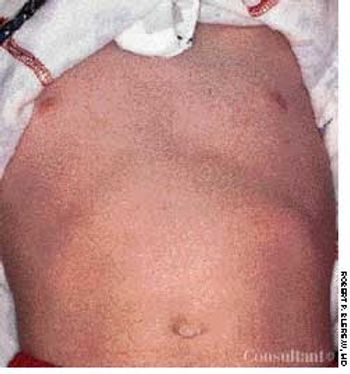
This condition involves the invagination of a proximal segment of bowel (the intussusceptum) into a more distal segment (the intussuscipiens). It occurs most frequently in infants between the ages of 5 and 12 months and is a leading cause of intestinal obstruction in children aged 2 months to 5 years. Intrauterine intussusception is associated with the development of intestinal atresia. The male to female ratio is approximately 3:2. Intussusception is slightly more common in white than in black children and is often seen in children with cystic fibrosis.

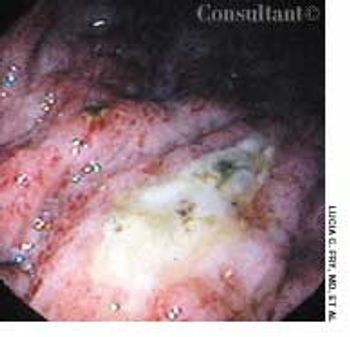
HIV infection was diagnosed in a 34-year-old man 3 years before he was hospitalized. The patient had a 2-week history of nausea; vomiting; and diffuse, intermittent, poorly localized abdominal pain. He had received radiotherapy and chemotherapy for Kaposi's sarcoma (KS) of the upper and lower extremities, which had been diagnosed 8 months earlier.

A 2-year-old girl presented with a 2-day history of urinary frequency and dysuria. Physical examination revealed complete fusion of the labia minora. Urine culture showed Escherichia coli with a colony count of 108/L. The child was treated with a 10-day course of amoxicillin that resulted in complete clearance of the urinary tract infection.

A 55-year-old woman complained of the sensation of a foreign body in her swollen left upper eyelid. A hard, painless lump was readily discerned during palpation. Eversion of the left upper eyelid revealed a fleshy, red, sessile conjunctival mass. No purulent drainage was noted.

Significant burning and tearing of her eyes and eyelid swelling occurred soon after a 49-year-old woman had a permanent at a hair salon. Her ears also showed signs of a toxic burn. She had never before experienced such a reaction.

A 19-year-old man was admitted to the hospital with malaise, fatigue, and intermittent fever (temperature of 38°C [100.4°F]) for the last 2 weeks. Physical examination revealed scarce purpuric lesions over the lower extremities; a pericardial friction rub was audible over the precordium when the patient was supine and seated, and the spleen was remarkably enlarged.

A 49-year-old man was concerned about a right flexor forearm lesion that had been increasing in size for 6 weeks. The light pink, well-demarcated, 5-cm, circular lesion featured slight peripheral elevation with ulceration, crusting, and a relatively clear central area. A culture of material from the lesion was negative for fungi. A potassium hydroxide evaluation was not performed.

A 30-year-old woman had an extensive psychiatric history of anxiety and depression. She was concerned that the numerous lesions on her body might be signs of possible infection or infestation. The patient was undergoing treatment for multiple addictions to drugs, primarily methamphetamine (“crank”).

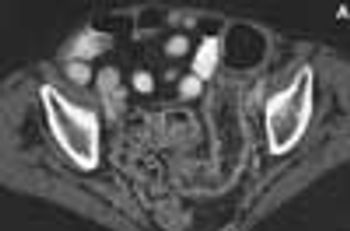
For 2 months, a 73-year-old man had experienced dysuria, pneumaturia, and foul-smelling urine. He had an attack of diverticulitis a year earlier. At that time, he underwent a barium enema study, which showed multiple sigmoid colonic diverticula with spasm.

A 72-year-old woman was hospitalized after 8 years of pain and swelling of the right metatarsophalangeal joint. (In this film, the dark area over the distal joint of the large toe is an artifact.) Results of a purified protein derivative tuberculin test were positive, and a chest film revealed apical changes compatible with old tuberculosis (TB).

A 35-year-old woman complained of pain or a burning sensation on her tongue when she ingested hot or acidic food and beverages. The white patch had spontaneously developed on her tongue 3 months earlier.

The appearance of a wound on the hand of a 102-year-old man concerned his nursing home's staff. Several months earlier, the patient had had a squamous cell carcinoma removed from the wound site and had undergone subsequent radiotherapy. A nonhealing skin ulcer developed at the site; a skin graft was performed.