
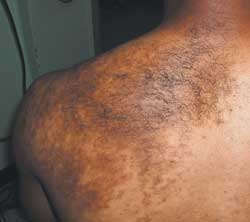






























































































































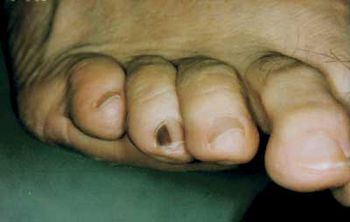
During a routine physical examination, a 3-mm dark brown streak is noted on the fourth toe of a 54-year-old man.
During a routine physical examination, a 3-mm dark brown streak is noted on the fourth toe of a 54-year-old man.

Here Dr Scheinfeld provides a pictorial guide to neurotic excoriation, perforating folliculitis, chondrodermatitis nodularis chronica helicis, hyperkeratosis, and intertrigo.
Apreviously healthy 47-year-old woman presents with an ascending, nonpruritic rash of 3 days’ duration on her legs. She reports that the rash began on her ankles following a day of gardening. She does not recall any recent insect bites and denies chest pain, dyspnea, abdominal pain, fever, arthralgia, arthritis, cough, and hemoptysis. She has never had a similar rash before. The patient’s only medication is an oral antihistamine for seasonal allergies. She has no known drug allergies.
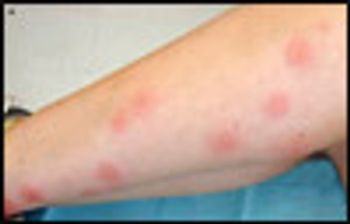
Intensely pruritic lesions of acute onset are evident on the legs of a 24-year-old woman who had no history of similar episodes. She was in excellent health and took no medications. She had spent the previous evening seated outdoors at a restaurant.
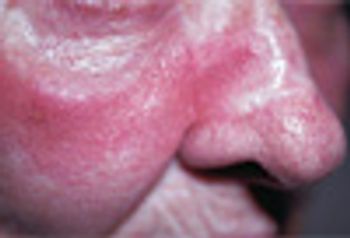
An itchy facial rash of 1 week's duration prompts a 72-year-old woman to see her primary care provider. She reports that redness and scaling had developed on her cheek, and that vitamin E oil she applied to the area seems to have made it worse.
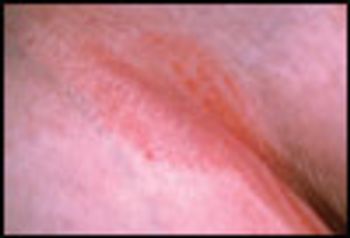
An obese 60-year-old woman presents with a chronic malodorous, itchy rash in her groin.
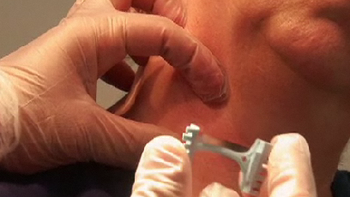
Dr Shroff, GP in Nottingham, demonstrates a shave biopsy.
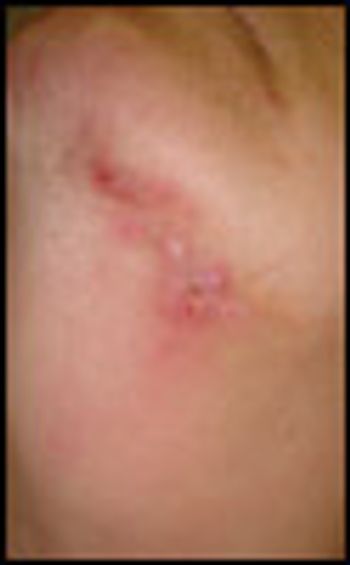
For more than a year, a 65-year-old woman had a nonpainful but nonhealing erythematous papule in the left submandibular area. She denied any unusual exposures or work history. Her most recent dental examination was several years earlier.
Match the following characteristics with the clinical disorders pictured in the photographs of Cases 1 and 2. Then read the brief descriptions that follow on the next page to see how well you did.
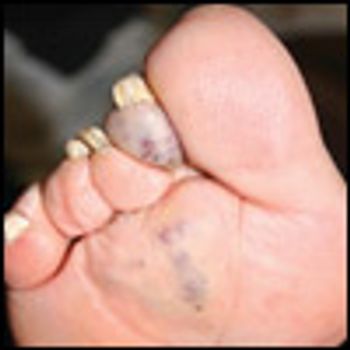
The plantar aspect of this toe shows purple nonuniform darkening that mimicked either a simple traumatic hematoma or the blue toe syndrome. More proximally, however, the solar aspect contained irregular dark-purple dots reminiscent of individual thrombosed venules, and in addition showed discontinuous purple zones more proximally in the part of the ray that lay within the body of the foot and that surely could not be imputed to any possible toe trauma or fracture nor to ischemia in the distribution of any single vessel. No purple area was warm or tender.
Because epidermal integrity decreases with age, eczematous inflammatory dermatoses are more common among older adults than among younger persons.
Dr Shroff, GP in Nottingham, demonstrates a punch biopsy.

Dr Shroff, GP in Nottingham, demonstrates the excision of a basal cell carcinoma.

Dr Shroff introduces a series of videos on skin surgery techniques.
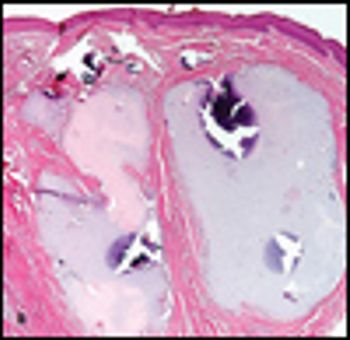
These lesions on the scrotum of an otherwise healthy 42-year-old man had gradually increased in size and quantity over the past 3 to 4 years. The firm, skin-colored papules and nodules ranged in size from 0.8 to 2 cm. The lesions caused occasional discomfort and itching. No inguinal rash or urethral discharge was noted. There was no sign of a hernia, and both testes were in the scrotum.
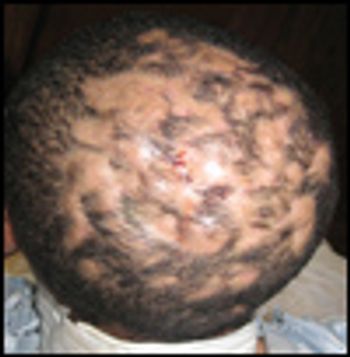
For the past 7 years, a 32-year-old African-American man had multiple nonpruritic scalp abscesses. He also reported intermittent fever and joint pain. The abscesses had been drained on many occasions, and he had received several antibiotics, although no organisms had been isolated. Collagen vascular disease, SAPHO syndrome (synovitis, acne, pustulosis, hyperostosis, osteitis), discoid lupus, and cutaneous sarcoid had been ruled out. During the past 7 years, he had been treated with prednisone, methotrexate, and hydroxychloroquine without any response.
Many elderly patients have fragile, atrophic skin.
Analogies often help make explanations clearer to patients.
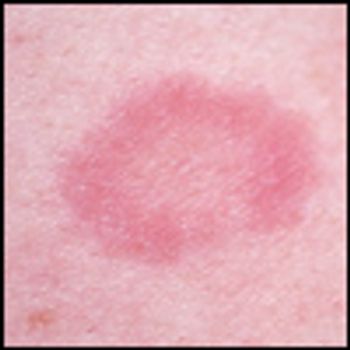
A 45-year-old man presents with a 4- to 5-year history of an intermittent, asymptomatic, red, circular rash on his trunk. Trials of antifungal creams have not been successful. The patient is otherwise healthy and takes no medications.
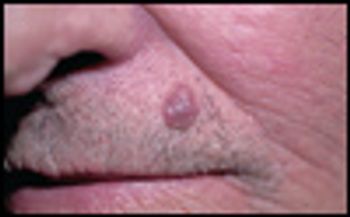
During a routine skin examination, a papule of several years’ duration is noted on the upper lip of a 71-yearold man. The patient states that the lesion has been slowly enlarging; it does not bleed even during shaving.
We published a question from John Mosby, MD, who wanted to know why the zoster vaccine had been administered to an older man in an earlier Photoclinic case who had ophthalmic zoster. We also published the response from Dr Tran, which cited the Advisory Committee on Immunization Practices (ACIP) recommendation to administer the vaccine to all patients 60 years or older in whom it is not contraindicated, including those with a history of previous zoster.
A 5-year-old boy was brought for evaluation of left leg pain. He had awoken with the pain 2 days earlier.
A papular lesion developed rapidly during the previous 11 days on the left forearm of an 89-year-old man. Another patient noticed a similar growth that developed over a 3-week period on his finger.
This lesion looks suspiciously like a malignant melanoma.
A 60-year-old laboratory technician complained of a pruritic rash on and around her left ear. It had appeared a few days earlier, shortly after she cleaned her telephone receiver with a disinfectant. A tentative diagnosis of contact dermatitis was made, and treatment with a hydrocortisone cream was initiated.