

































































































































A 3-year-old girl discovered lesions on her instep and great toe, where there was significant pressure from the old rubber sandals that she had been wearing.
A 3-year-old girl discovered lesions on her instep and great toe, where there was significant pressure from the old rubber sandals that she had been wearing.
Two days after beginning therapy with amlodipine, this 30-year-old woman noticed a pruritic, erythematous, macular dermatitis on her ankles.
What is the best way to obtain skin scrapings and evaluate them for evidence of fungal infection?
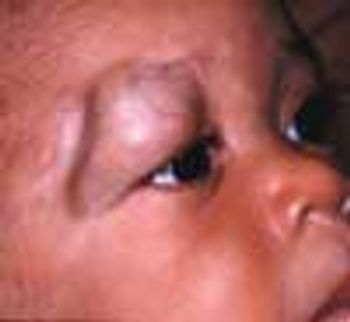
A 3-month-old boy was initially evaluated for a skin-colored, 1 × 3-cm, diffuse swelling in the right superior orbit area. The lesion had been slowly growing for a month and was asymptomatic. He was referred to a pediatric ophthalmologist who administered 2 corticosteroid injections intralesionally.
Excessive sweating may be caused by a variety of conditions or prescription drugs.
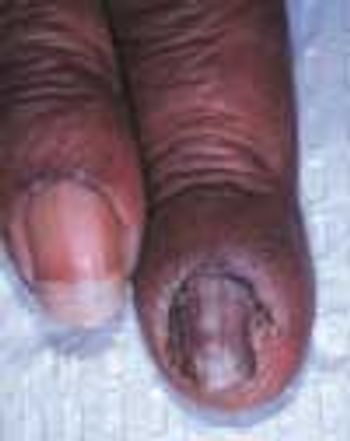
A 70-year-old woman complained of an infection in the right index fingernail and surrounding skin of 18 months' duration. The modest swelling and tenderness of the proximal paronychial tissue, faint nail dystrophy, and separation of the cuticle from the nail plate had persisted despite several courses of oral and topical antibiotics. The patient had occasionally seen pus seeping from underneath the cuticle. Results of a bacterial culture, performed by another physician, were negative.
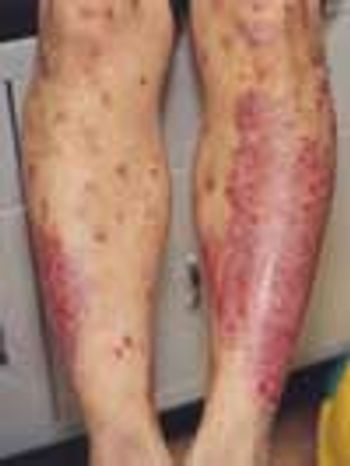
A 13-year-old boy presented with an explosive eruption of numerous, small, round, erythematous, itchy plaques on his lower back and lower limbs of 2 weeks' duration. Some of the lesions were scaly. His nails were normal. There was no evidence of arthritis or joint deformity. He had a sore throat a month before the onset of the rash but did not seek medical attention. He was not taking any medication and had no history of joint pain or family history of skin problems.
In Dr Henry Schneiderman's interesting case of swelling and redness of the lids in an elderly woman, the photograph clearly illustrates a sharp demarcation of the area of swelling above the cheekbone.
Is this acneform eruption on a middle-aged woman’s face perioraldermatitis? Rosacea? Pyoderma faciale? Is this pruritic rash related to ayoung woman’s tanning salon visits? Scrutinize the photos, make yourdecisions, and compare your answers with an expert’s.
Rickettsia rickettsii is transmitted tohumans by a tick bite. This boy hadbeen camping a short time beforea fever and the classic rash of RockyMountain spotted fever developed.The erythematous macular rashfirst appears on wrists and anklesand spreads to the trunk. Note thepuffy appearance of the skin resultingfrom vasculitis.
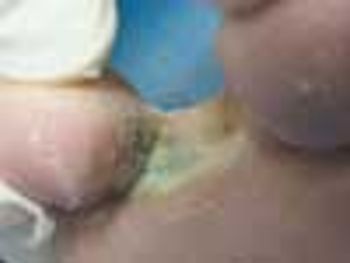
For a year, a 31-year-old man had asymptomatic, malodorous discoloration of the toe web spaces. He stated that his feet perspire heavily in the boots he is required to wear for work.
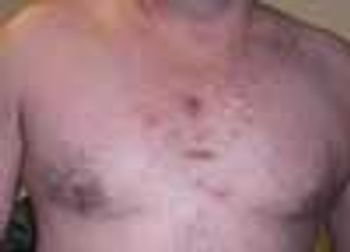
Painful cysts on the sternal and left axillary regions that had worsened over the past 3 weeks prompted a 42-year-old man to seek medical care. He reported that similar lesions in the same distribution first arose when he was 25 years old, and they recur each year. He denied having cystic acne in adolescence.
Appropriate foot care, preventive measures, and early intervention reduce the incidence of complications and lower extremity amputation in patients with diabetic foot ulcers. A thorough lower extremity examination includes assessment of the skin, interdigital areas, skin quality and integrity, and ulcerative or pre-ulcerative changes. The key to prevention is patient education and lifelong commitment to self-care.
This 9-year-old girl had a slightlypruritic perioral rash for 6 months.The skin around her mouth wasred, scaly, thickened, and hyperpigmented.She also had eczematouslesions in the antecubital andpopliteal fossae.
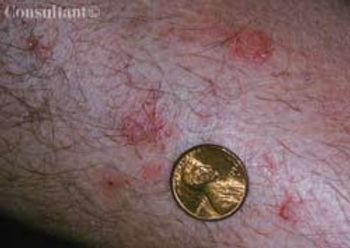
The multiple, uniformly scaly, coin-shaped, papulosquamous lesions shown here on the lower leg of a 61-year-old man had persisted for 3 months despite application of topical clotrimazole and 1% hydrocortisone. The rash involved only the legs and was variably pruritic. The patient had a long history of dry skin.

For 3 days, a 5-month-old infant had a red, papular, nonpruritic rash around her mouth and vesicles on her hands. The child was being breast-fed by her mother, who had a similar rash around her nipple. The child was afebrile, and the physical examination revealed no abnormal findings. There was no history of allergy or change in diet.
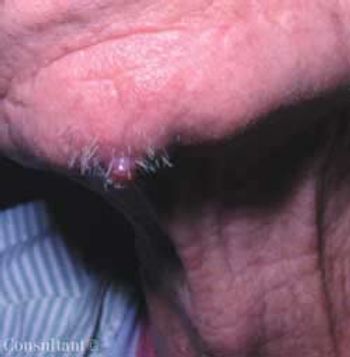
he sudden appearance of an asymptomatic, 6 x 4.5-mm, exophytic, red nodule on the chin prompted an ostensibly healthy 73-year-old nonsmoker to seek medical attention. His nodes were not enlarged, and he had no other skin lesions.
ABSTRACT: Rely on the history and physical findings when you evaluate a hand injury. After you control any active bleeding, test the motor and sensory functions of the radial, ulnar, and medial nerves. Use the rule of the 5 P's-pulses, pallor, pain, paresthesia, and paralysis-to guide the vascular examination. Assess the muscles and tendons by testing their flexion and extension functions against mild resistance. After anesthetizing any wound sites, apply high-pressure saline irrigation to remove debris and reduce bacterial contamination to prevent infection. To repair skin injuries, use a closure method appropriate to the condition of the wound. Infection-prone wounds-such as crush, grossly contaminated, and bite injuries-may require antibiotic prophylaxis and possibly delayed closure.
For several months, a 59-year-oldwoman has had numerous asymptomaticlesions on her arms andlegs. During this period, she has notbeen exposed to the sun and hastaken no new medications.
When patients complain of malodoroushidrosis of the feet and they havetried every over-the-counter remedy,suggest they apply a regular underarmdeodorant/antiperspirant to theirfeet after showering
A 67-year-old woman with insulin-dependent diabetesmellitus and uncontrolled hyperglycemia complained offatigue and malaise. For 2 years, a draining ulcer hadbeen present on the bottom of her left foot.
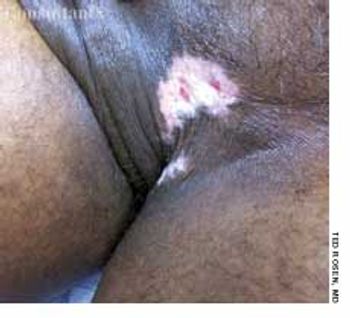
A 46-year-old man complained of “irritation” in the groin of several months’ duration. Ted Rosen, MD, of Houston noted a tender, macerated, hypopigmented plaque at the junction of the scrotum and upper inner thigh. At the periphery of the lesion was some detectable erythema and within the plaque were several small, superficial erosions.
A 20-year-old woman presents with a 3-week history of a pruritic, progressivelyenlarging erythematous lesion on one arm. She has a cat and recentlystarted horseback riding lessons. She is otherwise healthy and takes nomedication.
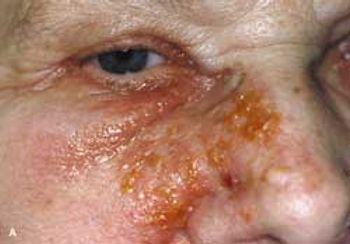
For a few days, this 73-year-old woman had had an itchy, painful rash on the right side of her face. Despite its proximity to her eye, she had no ocular involvement and no blurring of vision.
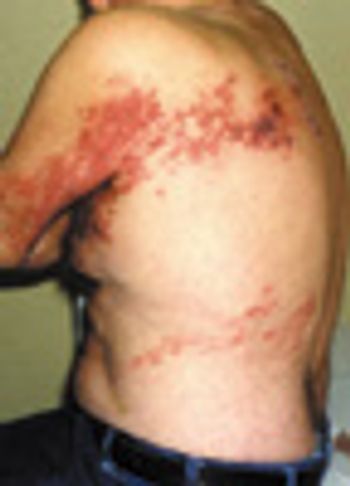
Two weeks earlier, this 66-year-old man had been hospitalized because of leftsided chest pain. However, cardiac evaluation revealed no abnormalities.